The Business Impact of AI Knowledge Management: An Implementation Guide
Last updated 11 months ago
In today's knowledge-based economy, effective management of corporate knowledge is not just a competitive advantage, but a strategic necessity. AI Knowledge Management (AI KM) is revolutionizing how companies capture, organize, and leverage their collective knowledge. This article examines the concrete business impacts of AI KM and provides a comprehensive guide for selecting and implementing the right solution for your organization.
The Transformative Power of AI Knowledge Management
AI Knowledge Management goes far beyond traditional document management systems. It leverages advanced technologies such as machine learning, natural language processing, and semantic analysis to not only store information, but also understand, connect, and contextualize it. This transformation brings measurable business benefits.
Quantifiable Business Benefits
1. Productivity Gains and Time Savings
Reduced Search Time: Employees spend an average of 2.5 hours per day searching for information. AI KM can reduce this time by up to 35%.
Accelerated Onboarding: New employees reach full productivity up to 50% faster with AI KM.
More Efficient Meetings: Meeting times can be reduced by an average of 20% through instant access to relevant information.
2. Improved Decision Quality
Data-Driven Decisions: 73% of companies with advanced knowledge management report improved decision quality.
Reduced Error Rate: The error rate in complex decisions can decrease by up to 40% when all relevant information is available.
Faster Decision-Making: The decision-making process is accelerated by an average of 50% when relevant information is immediately available.
3. Innovation Acceleration
Higher Innovation Rate: Companies with effective knowledge management report a 20% higher innovation rate.
Shortened Development Cycles: Product development times can be reduced by up to 30%.
Improved Idea Generation: The quality and quantity of new ideas increases through the connection of previously unconnected knowledge bases.
4. Risk Minimization
Knowledge Retention Despite Turnover: Up to 80% of critical tacit knowledge can be preserved through AI KM, even when key employees leave the company.
Compliance Security: Adherence to regulatory requirements is improved by up to 60% through comprehensive documentation and traceability.
Reduced Operational Risks: Operational risks due to information gaps or outdated knowledge are reduced by an average of 45%.
5. Cost Savings
Reduced Duplicate Work: Unnecessary repetition of work is reduced by up to 25%.
Optimized Resource Utilization: More efficient use of existing resources leads to cost savings of an average of 15-20%.
Lower Training Costs: Training costs can be reduced by up to 30% through context-based, on-demand knowledge transfer.
Industry-Specific Impacts
Manufacturing Industry
Improved Product Quality: Through consistent application of best practices and lessons learned
Optimized Maintenance Processes: Faster access to technical documentation and troubleshooting guides
Accelerated Product Development: Through effective use of historical development data and experiences
Mechanical Engineering
More Efficient Design Processes: Through reuse of proven designs and components
Improved Customer Specifications: More accurate capture and implementation of customer requirements
Optimized Supply Chain: Through better understanding of component specifications and alternatives
Chemistry and Pharmaceuticals
Accelerated Research: Through linking relevant research results and experiments
Improved Compliance: Comprehensive documentation of processes and procedures
Optimized Production Processes: Through capture and application of process knowledge
Energy Sector
More Efficient Plant Planning: Through access to historical project data and best practices
Improved Maintenance: Faster troubleshooting through context-based technical documentation
Optimized Resource Planning: Through better understanding of demand patterns and capacities
When is the Right Time for AI Knowledge Management?
Implementing AI Knowledge Management is particularly valuable for companies in the following situations:
1. Demographic Change and Knowledge Loss
Aging Workforce: When a significant portion of your workforce will reach retirement age in the next 5-10 years
High Turnover in Key Positions: With above-average employee turnover in knowledge-intensive areas
Shortage of Skilled Workers: When recruiting new experts becomes increasingly difficult
2. Complex Knowledge Landscape
Extensive Documentation: With more than 10,000 technical documents or several terabytes of documentation
Diverse Document Formats: When your knowledge exists in various formats (PDF, CAD, Office, etc.)
Multilingual Documentation: With documents in different languages that need to be used across the organization
3. Growth and Transformation
Mergers and Acquisitions: When integrating knowledge bases from different companies
International Expansion: When knowledge needs to be shared across different locations and cultures
Digital Transformation: As part of a broader digital transformation strategy
4. Operational Challenges
Long Onboarding Times: When new employees need more than 6 months to become fully productive
High Error Rates: With recurring errors due to lack of information or incorrect information
Inefficient Information Search: When employees spend more than 1 hour per day searching for information
5. Strategic Realignment
New Business Models: When developing new, knowledge-intensive business models
Product Innovation: When innovation is a central competitive factor
Service Transformation: When transitioning from product-centric to service-centric business models
Selecting the Right AI Knowledge Management Tool
Choosing the right AI KM system is crucial for the success of your initiative. The following checklist helps you systematically evaluate potential solutions:
Comprehensive Tool Selection Checklist
1. Document Processing Capabilities
Format Support: Supports all document formats relevant to your organization
OCR Quality: Offers high-quality text recognition even for scanned documents
Structure Recognition: Recognizes and preserves document structures such as headings, lists, tables
Diagram and Image Processing: Can extract information from technical drawings and diagrams
Multilingual Support: Supports all languages relevant to your organization
Versioning: Manages different document versions and their relationships
Metadata Extraction: Automatically extracts relevant metadata from documents
2. AI Functionalities and Intelligence
Domain-Specific Understanding: Understands the technical terminology of your industry
Contextual Understanding: Recognizes relationships between different documents
Semantic Search: Goes beyond keyword search and understands the meaning of queries
Source Citation: Provides precise source citations for all information
Confidence Scores: Provides confidence values for answers
Contradiction Detection: Identifies and flags contradictory information
Knowledge Synthesis: Can combine information from different sources
Learning Capability: Continuously improves through use and feedback
3. Integration and Technical Aspects
API Availability: Offers comprehensive APIs for integration with other systems
Existing Integrations: Has pre-built integrations with your core systems
Scalability: Can scale with your document volume and user numbers
Performance: Delivers answers within acceptable timeframes (typically <5 seconds)
Deployment Options: Offers your preferred deployment options (Cloud, On-Premise, Hybrid)
Technical Requirements: Is compatible with your existing IT infrastructure
Offline Capabilities: Offers offline access to critical information when needed
4. Security and Compliance
Data Encryption: Encrypts data both in transit and at rest
Access Controls: Offers granular, role-based access controls
Compliance Certifications: Has relevant certifications (ISO 27001, GDPR, etc.)
Audit Trails: Logs all system activities for compliance and security
Data Sovereignty: Stores data in your preferred regions
Data Separation Mechanisms: Ensures separation of your data from other customers
Security Reviews: Has undergone regular security audits and penetration tests
5. User-Friendliness and Adoption
Intuitive User Interface: Offers a user-friendly, intuitive interface
Mobile Support: Works on different devices and screen sizes
Personalization: Allows customization to individual preferences and workflows
Collaboration Features: Supports collaborative work and knowledge sharing
Comprehensive Documentation: Offers extensive documentation and training materials
Multilingual User Interface: Supports your employees' languages
Accessibility: Meets accessibility standards
6. Vendor and Support
Company History: Has a proven track record in your industry
Financial Strength: Has sufficient financial stability for long-term partnership
Support Options: Offers the support levels and channels you need
Implementation Support: Provides resources for implementation
Training Offerings: Offers comprehensive training for different user groups
Development Roadmap: Has a clear, transparent product development strategy
Reference Customers: Can provide references from similar companies or industries
7. Economic Viability and ROI
Transparent Pricing Model: Offers a clear, understandable pricing model
TCO Calculation: Enables calculation of total cost of ownership
ROI Metrics: Supports measurement of return on investment
Scalable Licensing: Grows flexibly with your requirements
Cost Transparency: No hidden costs for implementation or support
Value Proof: Offers opportunities for proof of value before larger investments
Contract Terms: Flexible, fair contract terms without excessive commitment
Structured Testing Approach for AI Knowledge Management Tools
A thorough testing process is crucial to ensure that the selected system meets your specific requirements. Here is a structured approach:
1. Preparation and Planning
Define Clear Testing Objectives
Identify the most important success criteria for your AI KM system
Establish measurable performance indicators (e.g., answer accuracy, speed, user acceptance)
Determine go/no-go criteria for the final decision
Create a Representative Test Team
Include representatives from different departments and functions
Ensure both technical and non-technical users are represented
Identify power users and occasional users for different perspectives
Develop a Detailed Test Plan
Define the timeframe and resources for the test
Establish the test environment and infrastructure
Create documentation templates for test results and feedback
2. Selection of Representative Use Cases
Identify 10-15 typical use cases that cover the full spectrum of your requirements:
Simple Information Queries
Search for specific facts or data (e.g., "What is the maximum operating temperature for pump XYZ?")
Retrieve definitions or explanations (e.g., "What does error code E-123 mean?")
Locate documents or resources (e.g., "Where can I find the maintenance manual for system ABC?")
Complex Problem-Solving Scenarios
Fault diagnosis and troubleshooting (e.g., "What could cause a pressure drop in the hydraulic system?")
Decision support (e.g., "What material options are available for this application and what are their pros and cons?")
Process optimization (e.g., "How can the energy consumption of this plant be reduced?")
Cross-Departmental Use Cases
Interfaces between development and production
Collaboration between sales and technical support
Knowledge transfer between research and application engineering
Specific Domain Requirements
Industry-specific terminology and concepts
Regulatory and compliance inquiries
Technical specifications and standards
3. Creation of a Representative Test Dataset
Document Selection
Select 5-10% of your total document inventory as a representative sample
Ensure all relevant document types and formats are included
Include both current and older documents
Ensure Document Diversity
Technical documentation (manuals, specifications, drawings)
Process documentation (procedures, workflows, best practices)
Knowledge articles and training materials
Project documentation and experience reports
External sources (standards, regulations, supplier documentation)
Build in Challenges
Documents with complex tables and diagrams
Multilingual documents
Documents with poor scan quality or OCR challenges
Documents with contradictory or outdated information
Very extensive documents (>100 pages)
4. Conducting Structured Tests
Accuracy Tests
Ask specific questions with known answers for each use case
Rate the accuracy of answers on a scale of 1-5
Document cases of misinformation or hallucinations
Verify source citations for correctness and relevance
Performance and Scalability Tests
Measure response times for different types of queries
Test the system under load with multiple concurrent users
Evaluate processing time for large document volumes
Check system stability under continuous use
Usability Tests
Have users perform typical tasks without prior training
Measure time to task completion
Collect qualitative feedback on the user interface
Evaluate the intuitiveness and learning curve of the system
Integration Tests
Test integration with your primary document management system
Verify authentication and access controls
Test API calls and data flows
Evaluate synchronization mechanisms
5. Evaluation and Decision-Making
Quantitative Evaluation
Create a weighted evaluation matrix based on your priorities
Rate each system against the defined criteria
Calculate overall scores for each tested system
Identify strengths and weaknesses of each solution
Qualitative Evaluation
Collect feedback from all test users
Conduct debriefings with the test team
Document subjective impressions and concerns
Evaluate cultural fit with your organization
Cost-Benefit Analysis
Calculate the total cost of ownership (TCO) for each solution
Estimate expected ROI based on your specific use cases
Consider both short-term and long-term costs and benefits
Assess risks and uncertainties
Decision-Making
Present results to relevant stakeholders
Discuss trade-offs and compromises
Make a data-driven decision based on your specific requirements
Develop an implementation plan for the selected solution
Implementation Strategies for Successful AI KM Adoption
Successfully implementing an AI Knowledge Management system requires a strategic approach that goes far beyond technical installation. Here are proven strategies for successful adoption:
1. Phased Implementation Approach
Phase 1: Pilot Project (2-3 Months)
Select a department or functional area with high knowledge management needs
Implement the system with a limited document set (5-10% of total volume)
Define clear, measurable success criteria for the pilot
Collect detailed feedback and improvement suggestions
Document early successes and challenges
Phase 2: Targeted Expansion (3-6 Months)
Expand to 2-3 additional departments or functional areas
Integrate additional document types and knowledge sources
Implement improvements based on pilot feedback
Develop internal champions and success stories
Refine metrics and ROI calculations
Phase 3: Enterprise-Wide Rollout (6-12 Months)
Scale to all relevant departments and locations
Integrate all critical knowledge sources and document repositories
Standardize processes and best practices
Establish governance structures for long-term success
Implement continuous improvement processes
2. Change Management and User Adoption
Stakeholder Engagement
Identify all relevant stakeholders and their specific interests
Develop tailored communication strategies for different stakeholder groups
Involve key stakeholders early in decision-making processes
Proactively address concerns and resistance
Communication Strategy
Develop a clear, consistent message about the value and benefits of AI KM
Communicate regularly through various channels (meetings, newsletters, intranet, etc.)
Share success stories and concrete examples of improvements
Create transparency about the implementation process and timeline
Training and Enablement
Develop role-specific training programs for different user groups
Offer various training formats (in-person training, webinars, self-learning materials)
Create easily accessible reference materials and FAQs
Implement a "train-the-trainer" program for sustainable knowledge transfer
Incentive Systems
Create incentives for active use and contributions to the system
Publicly recognize early adopters and champions
Integrate AI KM usage into performance reviews and development goals
Celebrate milestones and successes
3. Governance and Sustainability
Governance Structure
Establish an AI KM governance committee with representatives from different areas
Define clear roles and responsibilities for system administration and maintenance
Develop policies for data quality, updates, and archiving
Implement processes for conflict resolution and decision-making
Quality Assurance
Establish standards for document quality and metadata
Implement regular quality reviews and audits
Develop processes to identify and correct misinformation
Create feedback mechanisms for continuous improvement
Metrics and KPIs
Define clear, measurable performance indicators for the AI KM system
Implement regular reporting and dashboards
Link AI KM metrics to overarching business objectives
Use data for continuous optimization and resource allocation
Long-Term Development
Develop a multi-year strategy plan for AI KM
Plan regular system upgrades and expansions
Stay informed about technological developments and best practices
Create mechanisms for continuous learning and innovation
Conclusion: The Strategic Value of AI Knowledge Management
AI Knowledge Management is far more than just a technological upgrade – it is a strategic investment in the future viability of your company. In an era where knowledge is increasingly becoming the decisive competitive factor, AI KM offers the opportunity to more effectively use, preserve, and expand your organization's collective knowledge.
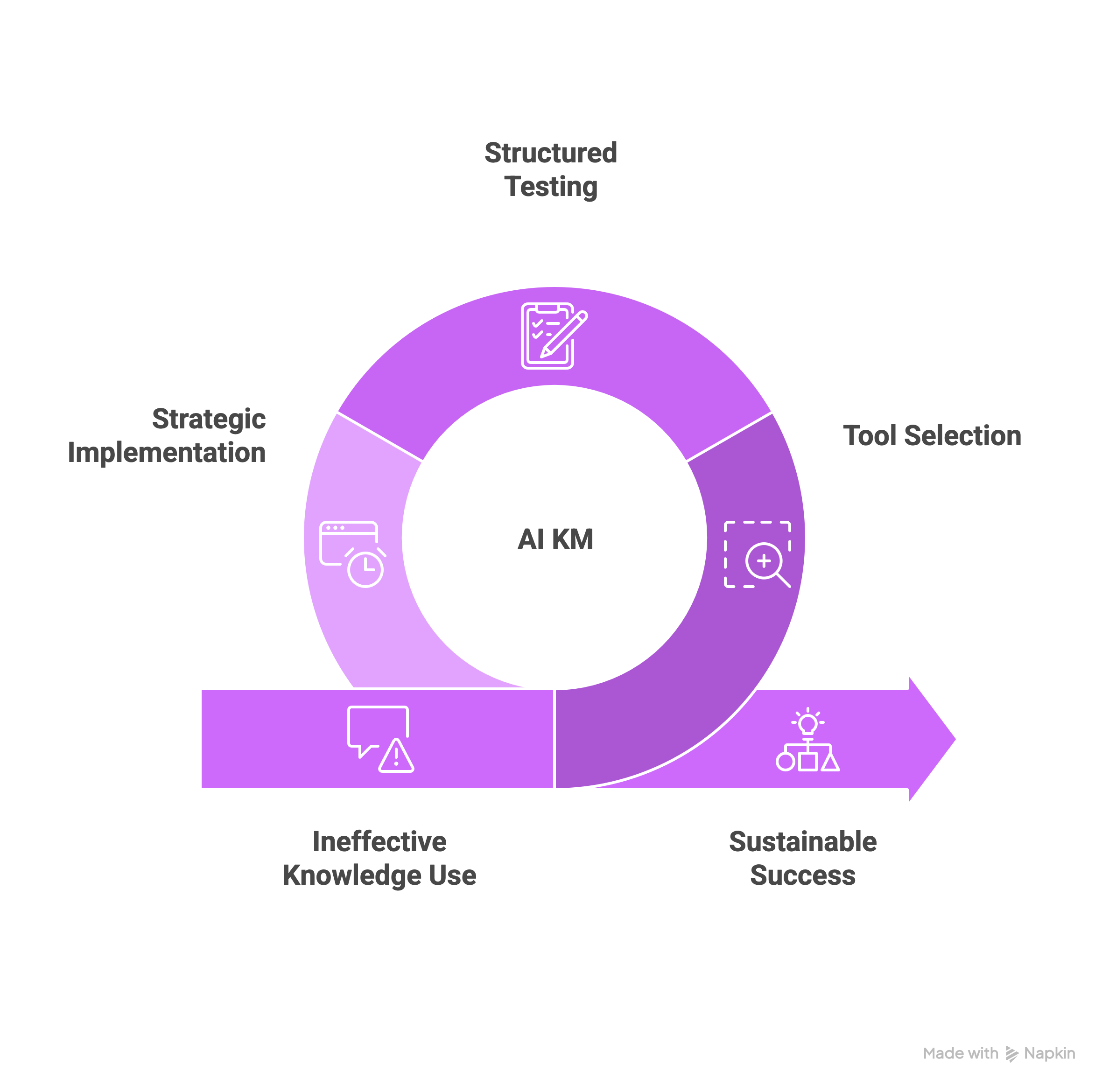
Successfully implementing an AI KM system requires a thoughtful approach that considers technological, organizational, and human factors. Through careful selection of the right tool, a structured testing approach, and strategic implementation, companies can fully leverage the transformative power of AI Knowledge Management.
The investment in AI Knowledge Management pays off in the form of higher productivity, better decisions, increased innovation, and reduced risk. Companies that invest in AI KM today are creating the foundation for sustainable success in an increasingly knowledge-based economy.