AI Knowledge Management vs. Conversational AI: Understanding the Difference
Last updated 12 months ago
What is AI Knowledge Management?
AI Knowledge Management (AI-KM) is a systematic approach to capturing, organizing, and leveraging an organization's collective knowledge using artificial intelligence technologies. Unlike traditional knowledge management systems, AI-KM goes beyond simple document storage by understanding context, relationships between information, and the specific terminology of your industry.
Core Components of AI Knowledge Management
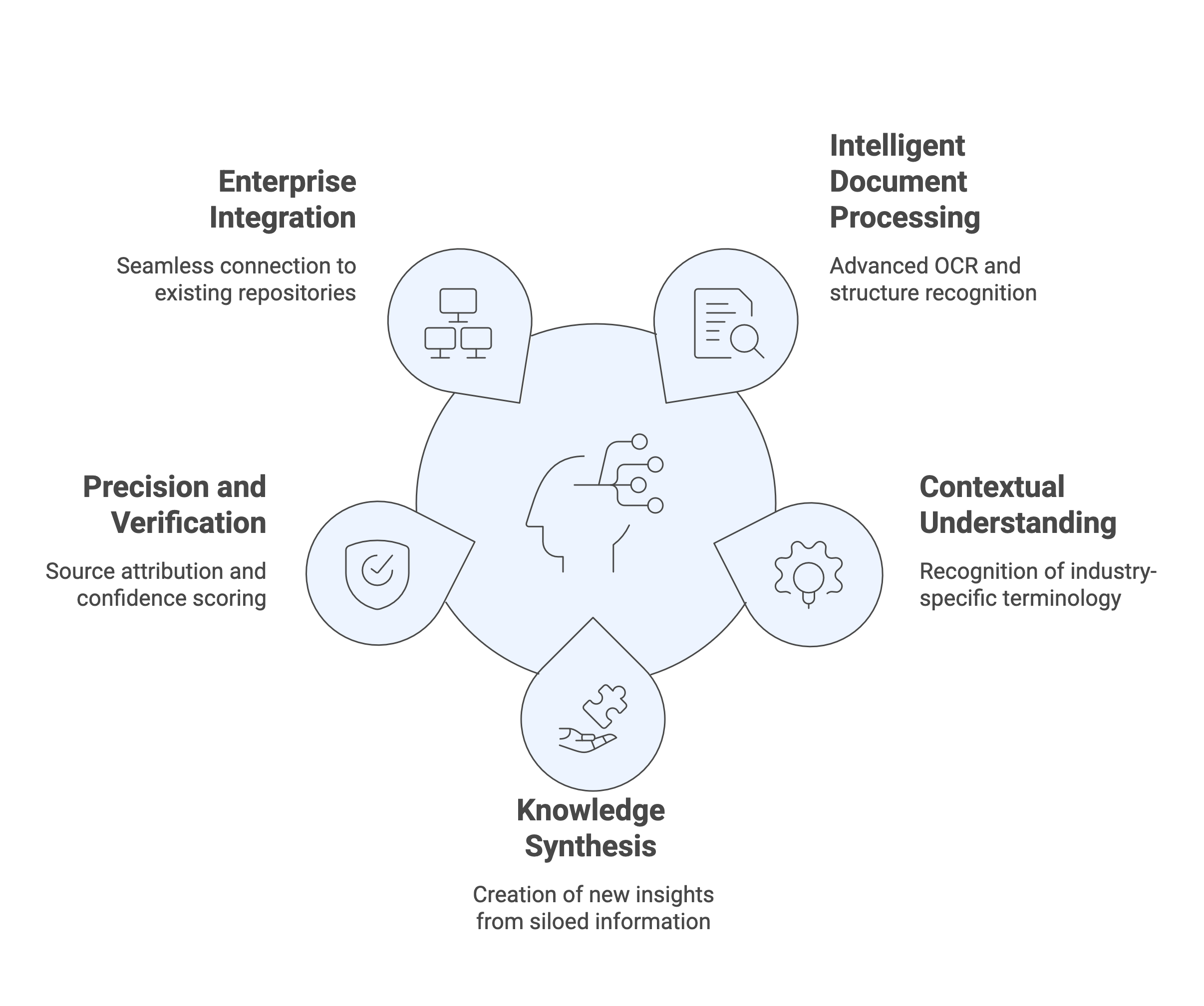
Intelligent Document Processing
Advanced OCR and structure recognition
Automatic extraction of tables, diagrams, and complex layouts
Preservation of document relationships and hierarchies
Contextual Understanding
Recognition of industry-specific terminology and jargon
Identification of relationships between concepts across documents
Ability to understand implicit knowledge within technical documentation
Knowledge Synthesis
Creation of new insights by connecting previously siloed information
Generation of summaries, FAQs, and structured knowledge from unstructured content
Identification of knowledge gaps and inconsistencies
Precision and Verification
Source attribution for all information
Confidence scoring for answers
Flagging of contradictions or outdated information
Enterprise Integration
Seamless connection to existing knowledge repositories
Secure, compliant handling of sensitive information
Scalable processing of large document collections
AI Knowledge Management vs. Conversational AI
While these technologies may seem similar at first glance, they serve fundamentally different purposes and have distinct capabilities:
Limitations of Standard Conversational AI for Knowledge Management
Standard conversational AI tools like chatbots face several challenges when applied to enterprise knowledge management:
Knowledge Limitations: Most conversational AI systems have knowledge cutoffs and can't access your latest documentation.
Hallucination Risk: Without proper grounding in your specific documents, conversational AI may generate plausible-sounding but incorrect information.
Context Blindness: General-purpose AI lacks understanding of your company's specific terminology, processes, and knowledge context.
Source Opacity: Conversational AI typically doesn't provide clear sources for its responses, making verification difficult.
Integration Challenges: Many conversational AI solutions aren't designed to integrate with enterprise document management systems.
Limitations of RAG chatbots in a business context
RAG (retrieval-augmented generation) chatbots represent an improvement over traditional chatbots, but still have significant limitations:
Limited context windows: Most RAG systems can only consider a limited number of documents at a time, which limits their ability to understand complex relationships.
Superficial document analysis: RAG systems often extract only text fragments without a deeper understanding of the document structure or the relationships between different documents.
Lack of domain adaptation: Without specific training for your industry or company, RAG systems often lack an understanding of technical terminology and contexts.
Limited synthesis capabilities: RAG chatbots are often unable to effectively merge information from different sources or generate new insights.
Why enterprise search is not enough
Enterprise search solutions offer important document search functions, but they are insufficient for modern knowledge management:
Keyword focus: Most enterprise search tools work primarily on a keyword basis and do not understand semantic content or context.
No information extraction: They display entire documents instead of extracting the specific information needed.
Lack of knowledge synthesis: Enterprise search cannot generate new insights by connecting different sources of information.
Limited interactivity: Users often have to formulate multiple search queries and navigate through numerous documents to find answers.
Static results: Results are not adapted to the specific context of the user or their role in the company.
The Business Impact of AI Knowledge Management
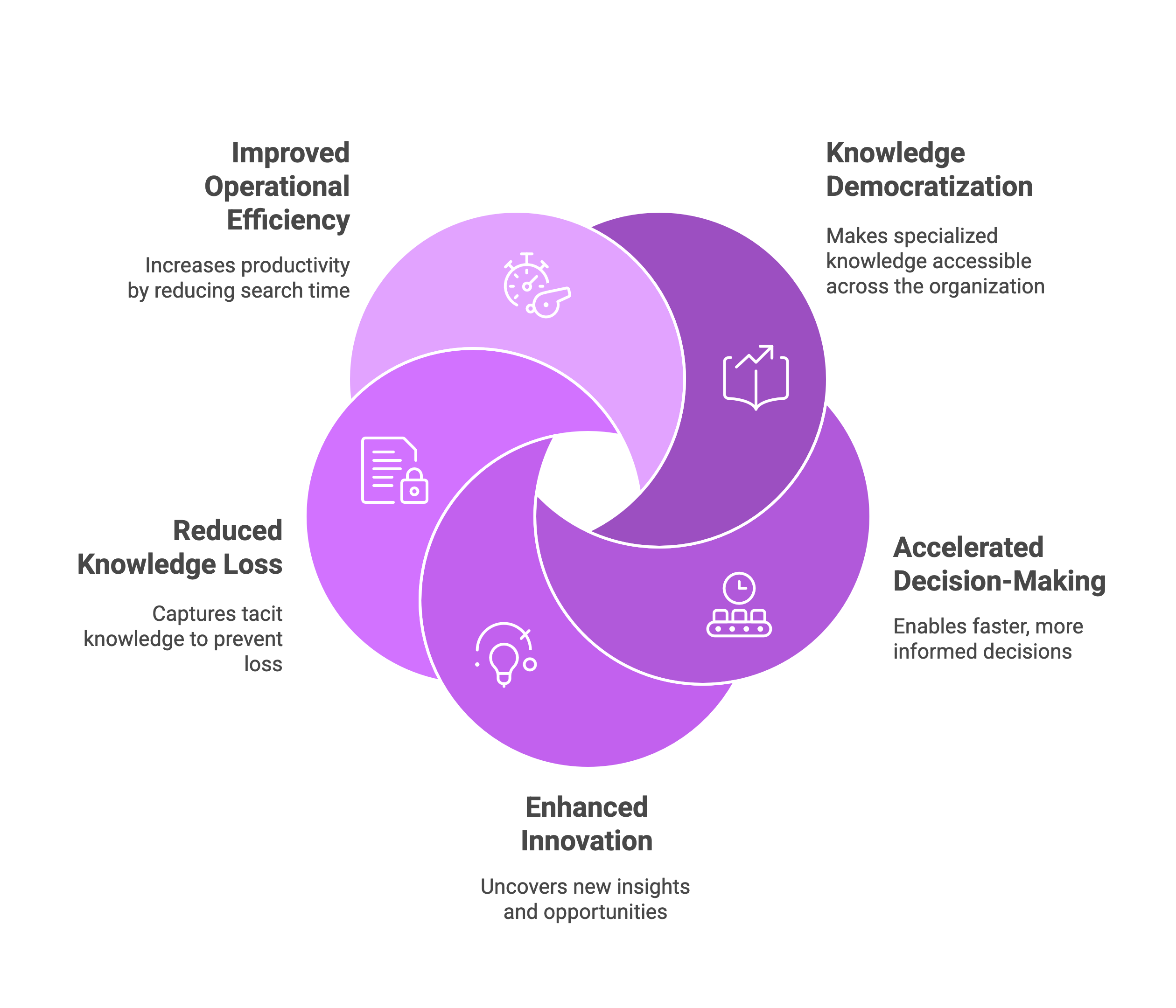
Organizations implementing AI Knowledge Management can expect several tangible benefits:
Knowledge Democratization: AI-KM makes specialized knowledge accessible across the organization, reducing dependency on individual experts and breaking down information silos.
Accelerated Decision-Making: By providing immediate access to relevant information with proper context, AI-KM enables faster, more informed decision-making at all levels.
Enhanced Innovation: When previously disconnected information is brought together, new insights and innovation opportunities emerge that might otherwise remain hidden.
Reduced Knowledge Loss: AI-KM captures tacit knowledge from documentation that might otherwise be lost through employee turnover or retirement.
Improved Operational Efficiency: Employees spend less time searching for information and more time applying it, significantly improving productivity.
Implementing AI Knowledge Management: Key Considerations
1. Document Preparation
While AI-KM can handle various document formats, organizations should consider:
Document quality and accessibility
Logical organization of existing repositories
Identification of critical knowledge sources
2. Integration Strategy
Successful AI-KM implementation requires thoughtful integration with:
Existing document management systems
Enterprise search capabilities
Workflow and collaboration tools
3. Governance Framework
Establish clear policies for:
Information security and access control
Content verification and quality assurance
Knowledge update and maintenance processes
4. Change Management
Drive adoption through:
Clear communication of benefits
Comprehensive training programs
Identification and support of internal champions
The Future of AI Knowledge Management
As AI technologies continue to evolve, we can expect AI-KM systems to become increasingly sophisticated:
Multimodal Understanding: Processing and connecting information across text, images, video, and audio.
Proactive Knowledge Delivery: Anticipating information needs based on user context and delivering relevant knowledge without explicit queries.
Collaborative Knowledge Creation: AI and human experts working together to create new knowledge assets.
Cross-Organizational Knowledge Networks: Secure sharing of non-sensitive knowledge across organizational boundaries.
Conclusion
AI Knowledge Management represents a fundamental shift in how organizations capture, organize, and leverage their collective expertise. Unlike conversational AI, which primarily facilitates natural language interactions, AI-KM provides a comprehensive framework for transforming unstructured documentation into actionable intelligence.
For industrial companies with complex technical documentation accumulated over decades, AI Knowledge Management offers a path to unlock the full value of their institutional knowledge. By making this knowledge accessible, verifiable, and contextually relevant, AI-KM enables organizations to make better decisions, innovate faster, and operate more efficiently in an increasingly competitive landscape.